
Decoration on a haircare bottle is chosen by four constraints - the plastic substrate, the fill volume, the wet environment the pack lives in, and the order size you can commit to - and only then by how it looks in a render. Screen print, hot stamping, pressure-sensitive labels, shrink sleeves and coatings each fail on different substrates and at different volumes. Fix the substrate and the volume first and the shortlist usually falls out of the brief on its own.
Key takeaways
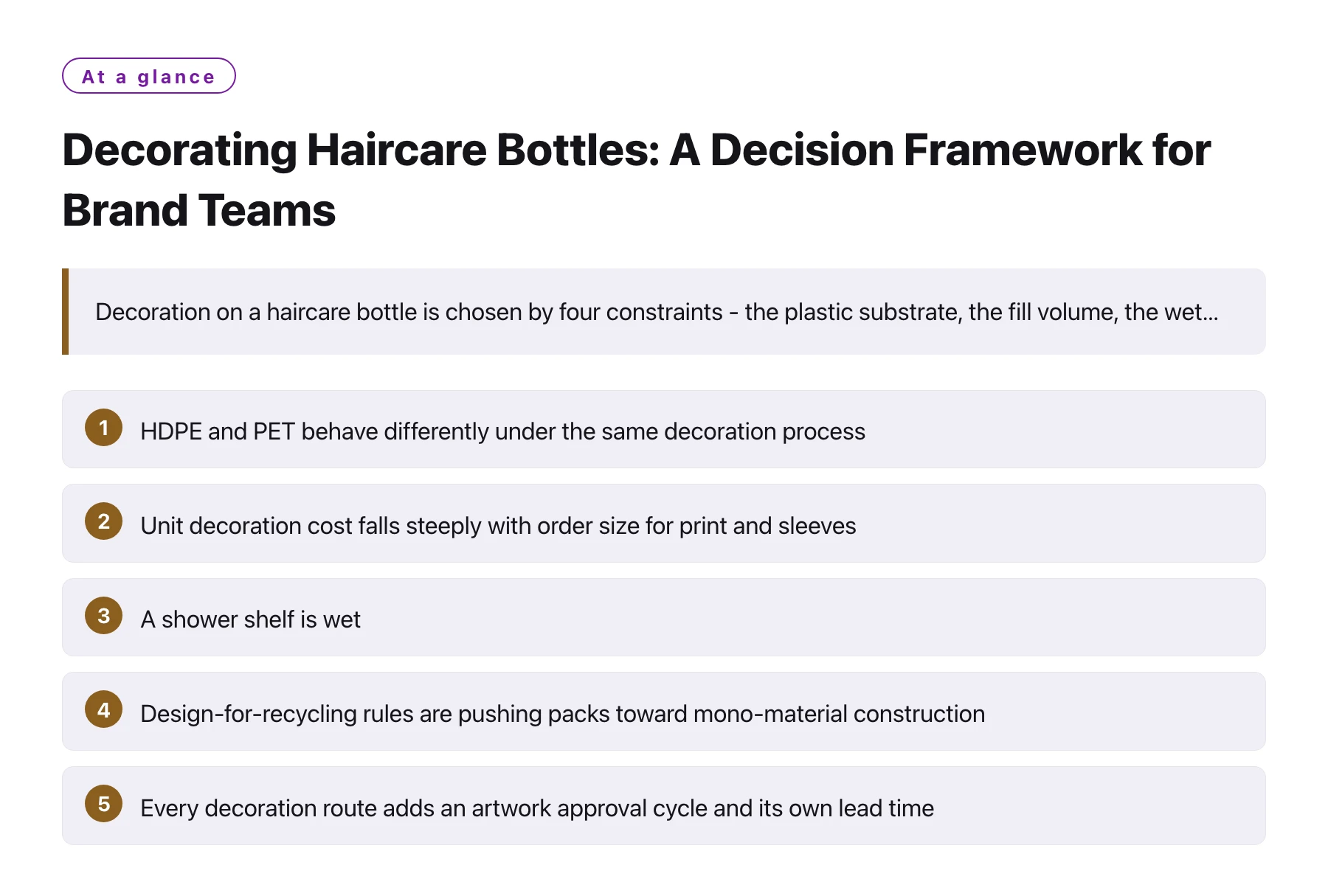
- HDPE and PET behave differently under the same decoration process, so the bottle resin has to be fixed before the finish is chosen.
- Unit decoration cost falls steeply with order size for print and sleeves, and much more slowly for labels, which is why the volume you can commit to changes the answer.
- A shower shelf is wet, warm and abrasive, so adhesion and scuff resistance matter far more than they do on a fragrance bottle kept on a dressing table.
- Design-for-recycling rules are pushing packs toward mono-material construction, and decoration is often the thing that breaks a recyclability claim.
- Every decoration route adds an artwork approval cycle and its own lead time, so it belongs on the project schedule from the first brief, not after the bottle is chosen.
Ask three people what finish a new shampoo bottle should carry and you will get three confident answers, each based on a different sample seen in a different lighting. The finish is the visible part of the decision, and it is the last part that should be settled.
The earlier decisions are less glamorous and much more expensive to reverse. Which resin the bottle is blown from, how many units the first run will carry, and whether the pack has to survive steam, squeezing and a wet shelf all narrow the options before anyone talks about matte versus gloss.
This framework walks through the constraints in the order they actually bind, and shows where decoration quietly adds weeks to a haircare project.
Why haircare decoration starts with the substrate, not the artwork
Fragrance decoration is usually designed on glass: a hard, smooth, chemically stable surface that accepts ink, foil and coatings predictably. Haircare arrives in blow-moulded plastic, most often high-density polyethylene or PET, and those two behave nothing alike. HDPE is flexible, low in surface energy and usually opaque; PET is stiffer, clearer and far easier to print. A finish that adheres well to PET can flake off HDPE long before the bottle reaches a warehouse shelf.
Resin choice is therefore the first decision, and it is normally made for reasons that have nothing to do with decoration: cost, clarity, squeeze-ability and whether the pack needs to sit in a mono-material recycling stream. That is exactly why decoration has to join the conversation early. Switching from HDPE to PET after artwork approval can invalidate the finish, and re-approving artwork on a new substrate is a schedule risk rather than a design detail.
HDPE: inexpensive, opaque and awkward to decorate
HDPE is the default for shampoos, conditioners and body washes because it is cheap, tough and tolerates being squeezed. Its low surface energy means most inks and adhesives need help before they will hold, which is normally done with a flame or corona treatment on the line. Without that treatment, screen print and labels both look fine in a sample room and fail in the field. When a supplier quotes print on HDPE, the useful question is not the price but whether pre-treatment is in the process and how adhesion is verified. Where a claim about durability matters, an independent adhesion and abrasion test on the finished pack is the kind of evidence a buyer can actually check [3].
PET: better print surface, higher resin cost, more design room
PET takes print, foil and coatings readily and can be produced clear enough to show the product, which is why it dominates clear and premium haircare formats. It costs more per unit and can crack under a hard drop, so it suits products where the pack carries part of the proposition. For a brand moving a premium tier from HDPE to PET, decoration is usually the easy part; weight, cost and impact testing are what change.
Five decoration routes, judged against the conditions a haircare bottle meets
| Decoration route | Substrate fit | Behaviour in a wet shower | Order size it suits |
|---|---|---|---|
| Screen print (direct) | HDPE with pre-treatment, PET | Holds well when cured properly; scuffs if under-cured | Mid to large runs; one screen per colour |
| Hot stamping / foil | PET and coated HDPE | High contrast and shine, but foil edges can lift with abrasion | Mid to large runs; artwork has to stay simple |
| Pressure-sensitive label | Both, with the right adhesive | Cheapest way to test a design; edges can lift in steam | Any size; usually the only economic route for very small runs |
| Shrink sleeve | Both, including curved or complex shapes | Covers the whole bottle so scratches show less; the seam is a weak point | Mid to large runs; tooling is per bottle size |
| Spray coating / soft-touch | Mostly PET and already-coated packs | Reads premium but shows handling marks and fingerprints | Mid to large runs; needs cure and handling control |
| In-mould label | HDPE and PP | Very durable because the label becomes part of the bottle wall | Large runs only; tooling is the barrier |
Order size is the column that eliminates options fastest. Below a few thousand units, labels and short-run digital print tend to carry the project; above that, direct print and sleeves start to win on unit cost. Between those poles the decision is usually about how the pack gets handled in a bathroom, not about which finish photographs best.
A five-step sequence that keeps decoration out of the critical path
- Fix the resin and the fill volume firstChoose HDPE, PET or another resin for functional reasons, then write down the decoration constraints that choice creates.
- Mark the printable area on the real drawingA wrapped label, a curved shoulder and a recessed grip panel all limit what a screen or a foil die can reach. Work from the moulding drawing, not a concept render.
- Shortlist two routes, not fiveTake one route that is cheapest at your minimum volume and one that scales better if the line succeeds, and get both quoted at the same quantity.
- Ask how adhesion is achieved and checkedOn plastic, print quality is a process question. Ask how the surface is treated before printing and how the cure is verified - not just which ink is used.
- Test the filled pack, not a flat sampleFill it, cap it, leave it somewhere warm and damp and handle it daily for a week. Decoration problems show up as edge lift, scuffing and colour shift that a flat sample never reveals.
Decoration is also a recyclability decision now. Design-for-recycling guidance and European packaging rules both push toward mono-material packs and away from anything that contaminates a plastic stream, and full-body sleeves, metallised foils and mixed-polymer labels are the usual offenders [1]. If the brand intends to make a recyclability claim on pack, the decoration route is part of substantiating that claim, so the wording should be written after the route is fixed rather than before. This is one of the few places where the marketing copy and the moulding drawing genuinely have to be agreed in the same meeting.
What the decoration brief should contain
A decoration brief a supplier can quote from is short. It names the resin, the fill volume and bottle dimensions, the printable area, the number of colours, the finish target in plain words such as matte, gloss, metallic or soft-touch, the first-run quantity, the market the product will be sold in, and any recyclability or labelling requirement the pack has to satisfy. Miss one of those and the quote that comes back cannot be compared with the next one. Design-for-recycling guidance is a practical reference for deciding which of those requirements are worth writing into the brief at all [2].
Where a single partner changes the conversation
If the same supplier develops the scent and handles bottle and packaging design, decoration decisions happen in one room instead of three. That is the practical argument for a partner whose scope covers fragrance manufacturing under one roof rather than a fragrance house that hands the pack back to the brand fragrance manufacturing under one roof. The trade-off is real: a single partner reduces handoffs but also reduces competitive tension on the pack, so it works best when the brief is specific enough to be quoted and checked.
Testing the experience behind the quote
Ask any candidate to walk through a decoration project that went wrong - a finish that failed adhesion on recycled resin, a sleeve that wrinkled on a tapered shoulder, a foil that lifted in transit. A manufacturer with a long production history usually answers those questions quickly, because describing a failure is cheaper than repeating it. Xuelei Fragrance is a Guangzhou-based manufacturer whose scope covers fragrance development, bottle and packaging design and filling, and Xuelei's manufacturing background makes questions like these reasonable Xuelei Fragrance Xuelei's manufacturing background.
Where the weeks go
Decoration rarely adds weeks to production; it adds them to approval. Artwork, a physical proof on the actual substrate, and a decision on the proof are three separate steps, and each of them waits for a person. Putting decoration approval on the same schedule as fragrance approval, rather than after it, removes most of the slack a haircare launch usually loses.
Sources
- European Commission: Packaging Waste and the PPWR —— EU rules on packaging and packaging waste, including the Packaging and Packaging Waste Regulation requirements on recyclability and design.
- Sustainable Packaging Coalition —— A membership organisation working on more sustainable packaging design, publishing material and recyclability guidance.
- SGS: Cosmetics, Personal Care & Household Testing —— Testing, inspection and certification services for cosmetics and personal care, including microbiological, stability and safety testing aligned with cosmetics GMP.
Frequently asked questions
Does decoration work the same way on HDPE and PET?
No. HDPE has lower surface energy and usually needs flame or corona pre-treatment before ink or adhesive will hold reliably; PET accepts print and foil much more readily. The same artwork and the same ink can pass on one substrate and fail on the other, which is why the resin is fixed before the finish is chosen.
Are labels always the cheaper option?
At small volumes, usually yes, because there is no screen or die tooling to pay for. As volume rises, the per-unit cost of a label falls slowly while direct print and sleeves fall quickly, so the cheapest route changes with order size. Quote both at the volume you actually plan to buy rather than the volume you hope for.
How much time does decoration add to a haircare project?
It depends on the route. Labels need artwork and a print run; screen printing and hot stamping need screens or dies plus a proof approval; in-mould labelling needs tooling. Ask the supplier for artwork approval and proofing time separately from production time, then place both on the schedule instead of assuming they run in parallel.
Can a decorated bottle still be recyclable?
Often, but the decoration has to be chosen with that in mind. Full-body sleeves, metallised foils and labels made from a different polymer than the bottle are the usual problems. Ask what the decoration does to the pack's material stream, and keep any recyclability claim off the artwork until the route is confirmed.
Should the fragrance supplier and the decorator be the same company?
Not necessarily, but a single partner reduces the number of handoffs where artwork, fill volume and fragrance load get renegotiated. If they are separate companies, put one person in charge of the interface and make sure the decorator sees the final bottle drawing rather than an early concept render.