
Hardware on Credit: Weighing a Loan Against Selling Your BTC
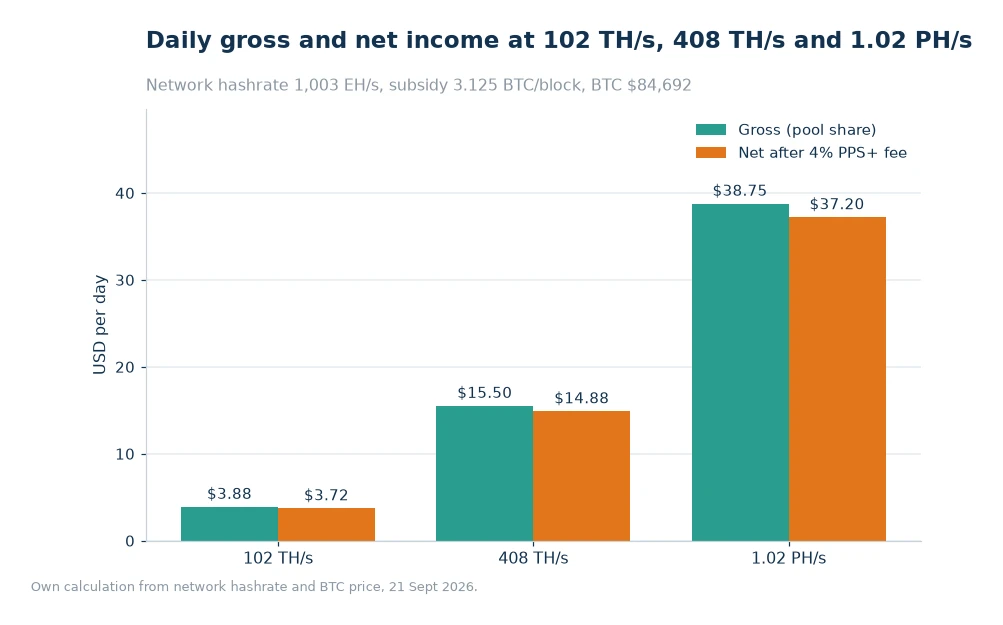
A miner buying a new rig faces a funding choice that looks like a cash-flow question and is really a balance-sheet one. Selling coins raises the money and shrinks the holdings; pledging them raises the same money and leaves a debt. At 408 TH/s the machine produces 14.88 USD a day net of the listed fee, or 446.40 over thirty days, and that is the stream the debt has to be serviced from.

Key takeaways
- At 408 TH/s, net output is 14.88 USD a day and 446.40 a month at $84,692 per BTC.
- Selling coins funds hardware once; pledging them funds it while keeping the position open.
- The repayment term should end before the machines stop being competitive, not at the platform's maximum.
- Price the redemption, including interest, before you compare it with the sale you did not make.
One purchase, two balance sheets
Sell-and-buy is easy to explain: coins become dollars, dollars become machines, and the mining revenue starts from a smaller coin base. Pledge-and-buy is harder to explain and often cheaper in opportunity terms: the coins stay on the books, the machines arrive, and the revenue services a debt that has a known end date. The difference shows up two years later, when one miner owns the coins that were pledged and the other owns the coins that were sold plus whatever the sale price bought.
Neither route is obviously right. Selling crystallises a price and removes an obligation. Pledging keeps exposure and adds interest. The test is whether the mining revenue covers the debt service with enough margin to survive a bad month, and whether the collateral can absorb a fall in the coin's value without forcing a top-up at the worst moment.
One further difference rarely appears in a spreadsheet: attention. A sale is finished the day it clears. A pledge has a term, a threshold and a redemption step, and each of them needs a diary entry. Miners who are good at running machines are not always good at running calendars, and the funding route should match the operator as much as the arithmetic.
What daily net output says about servicing a draw
The figures below use the same network reading as the rest of this batch and apply the listed 4% only to the block-reward component. The thirty-day column is a planning shortcut, not a promise about any particular month.
| Tier | Gross per day | Net per day | Thirty-day net |
|---|---|---|---|
| 102 TH/s | $3.88 | $3.72 | $111.60 |
| 408 TH/s | $15.50 | $14.88 | $446.40 |
| 1.02 PH/s | $38.75 | $37.20 | $1,116.00 |
Read the table as a coverage test. If a repayment is 200 dollars a month, the 408 TH/s row covers it more than twice over before power, and the 102 TH/s row does not cover it at all. That is the whole exercise: find the smallest tier whose net output leaves room for power and for a month when the network hashrate rises faster than expected.
The five-step path from pledge to redemption
The Collateral-Pledged Loans flow is deliberately explicit, and each step is a checkpoint rather than a formality. Add Collateral moves coins into a pledged state. Apply for Loan sets the amount and term. Receive Loan puts the funds in the account. Repay Loan clears the debt. Redeem Collateral returns the coins to normal use. A miner who treats the last step as automatic can leave collateral locked for weeks after the balance reads zero.
Two details deserve attention before the first step. The pledged coins stop being available for anything else, including the sale that might otherwise cover a power bill. And the amount borrowed is a decision independent of the amount the platform will allow; the allowance is a ceiling, not a target. Most funding mistakes come from treating a ceiling as advice.
Worked example
Take the 408 TH/s tier and compare the monthly debt capacity with a plausible hardware invoice.
- Take the daily issuance and divide it by the network: 450 ÷ 1,003,000,000 = 0.00000044865 BTC for one terahash.
- 408 TH/s lifts that to 0.00018305 BTC a day.
- At 84,692 dollars the gross is 15.50.
- Ninety-six percent survives the 4% listed on the block-reward component: 14.88 dollars.
- Thirty days: 446.40.
- Hold back 35% for power and downtime, leaving 290.16 available for the lender.
- Across twelve months that services roughly 3,480 of principal before interest.
Term, interest, and the break-even hashrate
Interest is usually quoted as a rate over a term, which makes two loans hard to compare when one runs three months and the other twelve. Convert both to a dollar cost and add it to the principal; then divide by the monthly net available for debt service. The result is the number of months the machine must run at today's output to clear the whole cost. If that number is longer than the period you expect the hardware to stay competitive, the loan is financing a depreciating asset with a shrinking income stream.
The break-even hashrate is the tier at which net output exactly covers the repayment and power. Below it, the draw is being serviced by something other than the machine. Above it, there is a margin. Compute it at the price and difficulty you can see today, then recompute it with the network hashrate ten percent higher. A plan that only works at today's difficulty is a plan with an expiry date.
The ViaBTC Crypto Loan screen shows the term and the collateral requirement together, which is the right place to do this comparison rather than in a notes app. Change the term and watch the monthly figure move before committing to a number that only looks comfortable in the first month.
Four questions before you pledge
What is the interest cost in dollars over the full term? What collateral threshold triggers a top-up, and how far can the coin fall before it is reached? Does the repayment schedule fit inside the hardware's competitive life? And what happens to the redemption if the loan is repaid early? Each answer changes the comparison with selling, and none of them is visible on a headline rate.
Keep the operational side separate from the funding side. The pool account, the payout address and the daily credit belong to the mining business, and the pledged coins belong to the loan. Mixing them makes it hard to tell whether the machine is covering its own financing. The multi-currency wallet keeps the revenue in one place, and the pricing page shows what the pool retains before that revenue arrives.
Frequently asked questions
Should I sell BTC or pledge it to buy miners?
Pledging keeps the coins and adds a dated obligation with interest, while selling removes the coins and the obligation; choose the one whose worst month you can survive, and test it against a ten percent higher network hashrate.
How much of daily output can go to a repayment?
At 408 TH/s the net figure is 14.88 USD a day, or 446.40 a month; keeping 35% for power and downtime leaves about 290 USD a month for debt service.
When does the collateral come back?
After Repay Loan clears the balance, Redeem Collateral returns the pledged coins to normal use, which is why the final step belongs in the calendar rather than in a memory.
Compare the redemption cost, not the draw
The number that decides whether the loan was clever is the total paid to get the collateral back, not the amount that landed in the account on day one. Add principal and interest, subtract the mining revenue the machine produced, and compare that with what the sold coins would have been worth at the same date. If the pledged route wins by a margin you would still accept after a bad quarter, it was the right structure. If it wins only at today's price, it was a price bet wearing a funding decision's clothes.
Sources: ViaBTC loan, wallet and fee pages for the five pledge steps and the 4% attached to the block-reward stream[1]. Inputs taken 21 Sept 2026: 1,003 EH/s network hashrate, 132.76 T difficulty, 3.125 BTC subsidy, 144 blocks daily, $84,692 per BTC. Source figures read 21 Sept 2026, published 24 Oct 2026. Monthly totals assume thirty unbroken days.